DONATIONS GRATEFULLY ACCEPTED


*****This is a labour of love but takes a great deal of time - any donations would be greatly appreciated*****

Saturday, March 16, 2019

#50 - More on Dick Grant

I've written about Dick (Richard Grant) in several posts (40, 41, 42, 43, 44, 47) and an article.  A friend of my great-grandfather Jack's, he sent postcards as he travelled across Canada headed to World War One.  I had no postcards in the collection that were sent from France while he was in active service.

The only information I had about Dick during the war was from his war records and from the war diaries of the 47th battalion.  The 47th Battalion C.E.F. (Dick's battalion) embarked for France from England on August 10, 1916 and were in the trenches on August 22.  By September 16, some of the men participated in a trench raid.


"On the night of the 16/17th September 1916 a successful operation consisting two raids on the enemy's trenches was carried out by the 47th Battalion with the object of capturing prisoners, gaining identification and helping operations in the South; the raiding parties each consisting of one officer and twenty five other ranks simultaneously assaulted two different points of the enemy's trenches at 12.20 AM on the 17th inst.
Raid B party led by Lieut. C.J. Keller accounted for at least nine Germans killed and captured ten prisoners.
Raid C party led by Lieut. J.A MacDonald captured no prisoners owing to the precipitate flight of the Germans in the sector of the trench entered by that party but at least 8 Germans were bombed or bayonetted.
At 12.35 AM returned to the points in their front line from which they had started out.
The raiding parties were assisted by an intense artillery bombardment which commenced at 12.15 AM & continued for five minutes on the front of the sector, box barrages were then formed round the points attacked for fifteen minutes followed by a repetition of the preliminary bombardment on front line for three minutes"

Raid B party included Private Richard Grant:


The parties included bombers and bayonetters.  Dick was the latter.  There is no indication as to whether he was responsible for any of the Germans captured (10) or killed (9), but Dick survived the raid apparently unscathed.


I really wished I had postcards from Dick while he was in France, but my collection ended when he was in England before going to the mainland.  A couple of weeks ago, however, my mother's cousin, who is in the process of moving homes, told me she had found three postcards that I might want (yes, please!).  She thought, perhaps, that they might be from Jack and that they should be reunited with the other postcards.  So she mailed them to me (fitting that they once again travelled through the mail).

They arrived a few days later safe and sound within bubble wrap and cardboard - a wonderful package to open a the end of a long, long winter.  The three are lovely examples of hand-embroidered postcards ("Silks") from France.  You can read more about this special postcard type at the Imperial War Museum website here.  And on the back ... the familiar signature of Jack's friend ... Dick.  I was so excited to get a bit more of his story.

Although I know that these were sent from France during the war, they were never postmarked, so I do not know the dates for certain. Dick died on April 13, 1917, so I can safely state they were sent before then and after he arrived in France in August, 1916.  Looking at the notes written on the back of the cards, though, can narrow it down a bit more.  Only two of the cards have messages.

The first we'll look at can be pretty well dated to mid-December 1916.  It is a Christmas card, and the note on the back reads:  "just a card to wish you all a happy Xmas. sorry that I am not with you.  just got back from leave. had a pretty good time. so I hope that you will have the same at Xmas  Dick"


According to Dick's war records, the only time he went on leave was December 2, 1916 for 10 days.  He'd have been back on the 12th or so, and sent this shortly after.


The next postcard has no writing on the back and no indication of when it was bought or mailed, but I'm thinking that Dick probably bought all three of these postcards at the same time when he was on leave.


I leave the most poignant one for last:


Poignant, of course, because this is a card of remembrance and he died sometime not long after writing this.  And because of the message on the back:  "Dear Mrs McCurrach (Jack's mother, Susanna).  just a P.C. to thank you for the nice box of candys (sic) that you was so good to send me, and I can tell you that it came at just the right time just as we came out o the trenches all wet and cold and I got other two boxes the same night, so we got a big fire going and got the parcels out and I wish that you could have seen us, getting away with that grub. we are getting it a bit hot just now out here and have lost a good lot of the boys.  I had a letter from Jack the other day will try and write him soon.  how is Gladys and Belle.   sorry that I cannot write more so thanking you again and hope to see you soon again. Dick"

Were these the last words Dick wrote to a McCurrach?  I'll never know.


Thursday, March 14, 2019

#49 - Happy Birthday Belle ... and Lumber

This birthday postcard was addressed to Belle McCurrach (Jack's Sister) and signed Gladys and Nellie (Jack having gone to war in February, 1917, it was most likely written between then and August 1919 when he came home). Belle's birthday was in June, so June 1917, 1918, or 1919.  The Postage on the back are two 1-cent Canadian stamps with King George V on them - 1911 or 1912 version, I believe.


Stating "Many happy returns of the day. Gladys and Nellie", the postcard doesn't appear to have been mailed.  Since they lived in the same city, perhaps they delivered it by hand or, for some reason, never sent it to her.

Okay - so all of that stuff is pretty straight forward and maybe a little boring.  The interesting part was when I looked up the address that Bella lived at.  Turns out (thanks to the 1919 Henderson's Greater Vancouver City Directory) that Bella worked as a domestic servant for a man named James Dick in a very swanky part of Vancouver.  Mr. Dick lived directly across from Gustave Roedde - Jack's employer before he went to war.  So I wonder if Jack's being employed by Roedde had anything to do with Belle getting the position as Mr. Dick's domestic servant.

James Dick was part owner (with his brother) of the Vancouver Woodyard, which was located at the south end of the Cambie Street Bridge (at one time known as the Connaught Bridge).  

Here is a photograph of the south end of the Connaught Bridge in 1915.  See if you can spot the lumber industry in BC (yes, I'm being sarcastic).

VPL SGN 996.3

False Creek at that time was an industrial area housing many sawmills, planing mills, foundries, steel works, machine shops, etc.  It was so polluted, it was also known as "shit creek".

I haven't found Vancouver Woodyard on the map, but they are in business by 1909 when their listing in the directory says "with Vancouver Lumber Co."  And the Vancouver Lumber Company is basically all the stacks of wood you see centre right in the photo.

The Dick brothers appear to have done alright for themselves.

I wonder if there was a distinct difference between "lumber" and "wood" at this time in Vancouver.  Perhaps the Dick brothers specialized in the better wood used for furniture and trim, while the Vancouver Lumber Company provided building lumber.  Not sure.


Wednesday, June 13, 2018

#48 - Christmas Joy for a Little Girl

Being only 4 days before Christmas, 2016, it seemed right to do a post on Christmas postcards in Jack and Nellie's collection.

Christmas Postcards used to be quite the fad.  As were those for birthdays, anniversaries, and other holidays.

Sometime in my grandmother's early life, she received a postcard to wish her a Merry Christmas.


Written on the back is simply "To Gladys":


This postcard would have to have been sent no earlier than 1914 as that is when Gladys was born.  And since the company that made it (Wolf & Co. N.Y) went out of business in 1931, it must have been sent before then.  

The first Christmas card was sent in 1843 (strangely the same year Dickens published "A Christmas Carol").  The card was created by Sir Henry Cole, the founder of the Victoria and Albert Museum.  All the Christmas letters he received from friends became too much to reply to, so he decided cards would be easier.  He had a friend design them and had 1000 cards printed to fill the need to reply to all of his correspondence.


The first Christmas Card - see article here.

Christmas cards continued to be in postcard format until, in 1915, someone found there wasn't enough room to write a long enough note on a postcard, and the book format was designed (ironic that the Christmas card started to eliminate writing letters, and then expanded to make room for writing a letter!).

Since the postcard format was going out of style, I think we can assume that this card to Gladys likely occurred in the first 10 years of her life (before 1924).  I assume when she was even younger based on the dates of the other postcards.


Friday, April 22, 2016

#46 - The Awesome Power of the Internet

Originally published 3/25/15

I had an amazing history day Monday.

Two complete strangers contacted me through my previous blog to share information!  How cool is that?  Thanks to those two men I now have more pieces to fit into my puzzle!

One of them, out of the blue, sent a photograph of the Woodpark Asylum.  If you remember, my great-great-grandmother (Helen Steele, nee McKenzie) worked there as I mentioned in this earlier blog post.


Thank you to Neil Gray (who contacted me and shared the picture) and to Russell at Turriff Printing Services whose pamphlet the photo was in and who got back to me when I asked if he knew where it came from (he did not).  The source of the photo is unknown at this time.  As it turns out, Neil works for the company responsible for The Ladysbridge Village development.  They now own the property and the buildings and are converting them into housing - nice looking housing.

In this photo (which is of the same series as the one I shared in that previous post) you'll see Ladysbridge Asylum, and I've circled the Woodpark building here (sorry it's black and hard to see - top centre):


In this photo, it is the building to the right of the picture in the little patch of woods:


What I had read was that it was about a mile distant.  I think it's closer.  

The other person who contacted me is a long lost relative.  He is the grandson of the child my great-grandmother stayed in Scotland to care for before coming to Canada (read about it here).  His grandmother, Peggy Black, is the reason I exist at all.  If she hadn't been in need of motherly care, my great-grandmother would have died on the Titanic.  

To my knowledge, our family had lost touch with her - apparently after she was married, because they knew her married name.  But here is her grandson (with all the research in hand, I might say) passing along photos and information to me.  Bless him.  Here's a photo of Peggy and her husband Bill Black.


I certainly see a family resemblance.

So not only am I learning about my family history, I feel like the family is being slowly brought back together as well.  How blessed am I?


#47 - Dick's Journey Across Canada Continued.

We already know that Dick (Richard Grant) got killed at Vimy Ridge, but I still have three more postcards that he wrote (and that, obviously, pre-date his death).  The first one listed here really should have been shared in the last post about him, as it is from the Rocky Mountains.  It is a "General View of New Grade Reduction Loops and Spiral Tunnels, Field, Canadian Rockies."


Oddly enough, I just drove through Field on Sunday with my family, and I mentioned the Spiral Tunnels in this past post.  But to re-cap, the spiral tunnels are train tunnels that loop around inside a mountain.  That way the grade could be lower than it would be on the surface, and it wouldn't be as dangerous for the trains and their crews.  In the first 6 km west of the Kicking Horse Pass summit, the Kicking Horse River drops 350m (1,150 ft), creating a 7 km long stretch of track with a 4.5% gradient called the Big Hill (a good 2.5% steeper than most modern railways).  The Big Hill was used (temporarily) from the completion of the Canadian Pacific Railway in 1885 for nearly 25 years until the Spiral Tunnels were completed in 1909 (only 6 years before Dick went through them on the train).  When dealing with the topography of the Rocky Mountains, sometimes you have to get creative - and these designers certainly did.  The tunnels still garner a lot of attention and have their own official stop with information panels explaining them.  You can read all about them here.

On the back of this postcard, Dick writes what is possibly the most poignant of all the messages to date.  Not because of what he wrote, but of what he was facing afterward:


"9th (or 8th) Nov 1915 On the train.  We are on our way to Berlin every one happy  Dick"

The second-to-last postcard from Dick to Jack is from the R.M.S. Missanabie, the ship he sailed the Atlantic on.  She was 520 feet long, 64 feet wide, had a depth of 41 feet and a gross tonnage of 13,000 (as noted on the front of the postcard - although another site stated 12,469 gt).  Built in 1914, the Missanabie was conscripted into use by the army and was torpedoed and sunk in 1918 off the coast of Kinsale, Ireland - in the same general area as the Lusitania 3 years before.


This one is post-marked Quebec City, but was posted from the ship.  The back reads:  "this is our boat we have got started all right.  started ___ on the 13th with a black crow on board.  we had the crow on our train so we are all right give my love to everyone and kiss Gladys for me  Dick."  Gladys was my then one-year-old grandmother.


It makes me rather sad to read these postcards now - knowing that Dick never came home, that he died in a nasty battle, that my grandmother never knew him, that he was lost to his family.  Just sad.  And that this hero was nearly lost to history's ravages (as were so, so many of them) is sad as well.


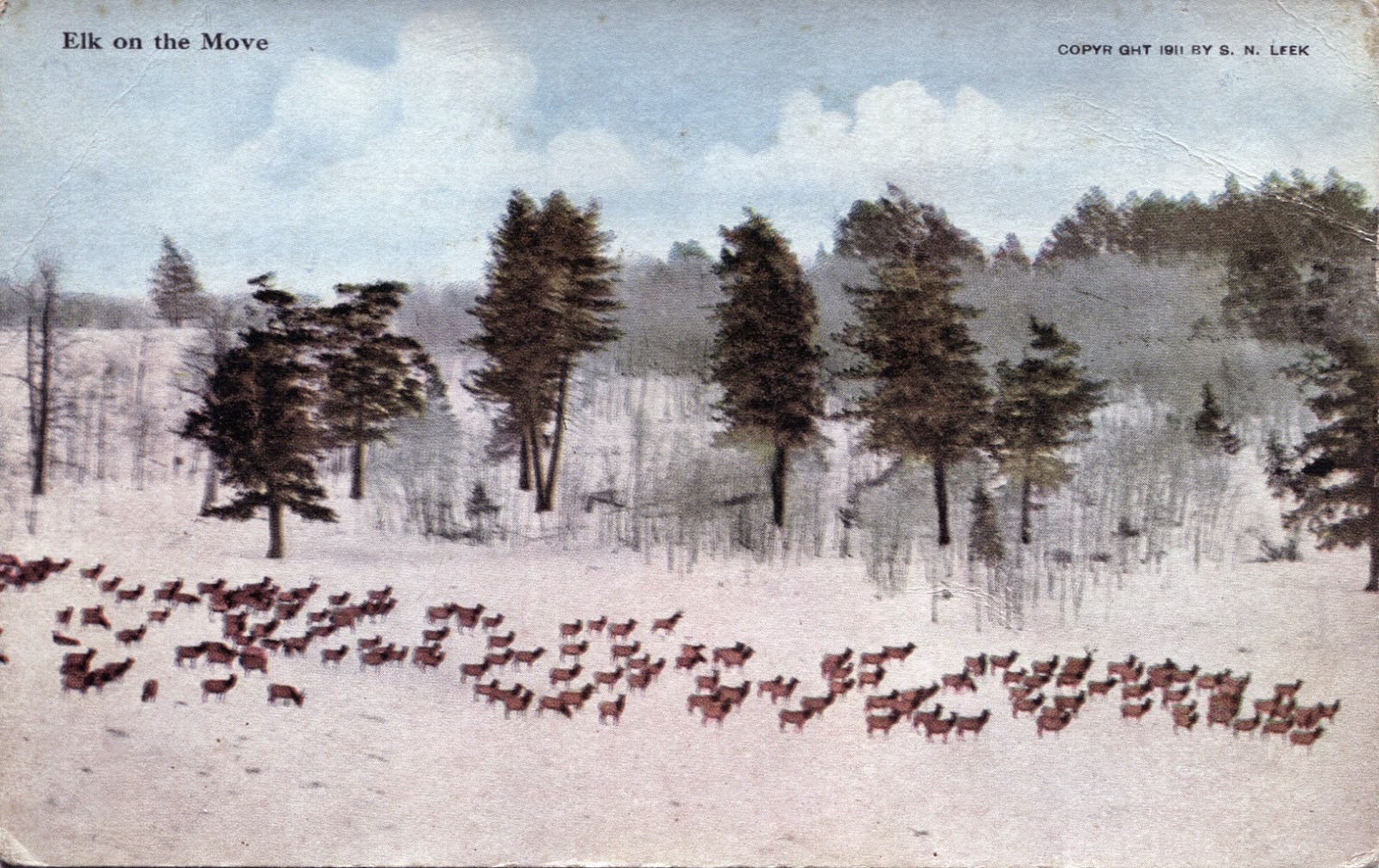
#45 - S.N. Leek and Elk!

When I wrote an earlier post about Atlin and the gold rush, I had this particular postcard in the pile to include with the others in that post.  But then I took a closer look at it ....

The postcard is (obviously) of a herd of elk.  And I assumed it was a herd of Elk from Atlin, because, well, that's where my head was.  But when you are doing history, you have to be a little more on the ball than that.  If you take a look, printed on the front of the card is: "COPYRIGHT 1911 BY S. N. LEEK," and on the back is printed:  "Copyright 1911 by S. N. Leek, Jackson, Wyo." as well as: "Portland, Oregon July, 1912."


Now, just because it is copyrighted by someone in Wyoming and has Oregon printed on the back does not mean that it wasn't bought in Atlin - and it may well have been - but I doubt it.  When I looked into S. N. Leek, I expected to find little if no information on a photographer over 100 years ago - the kind of stuff I normally find.  But this time I got a surprise.

The National Elk Refuge in Jackson Hole, Wyoming, was established in 1912 - in large part due to the actions of S. N. Leek.  I'll summarize, but if you are interested, the whole story can be read here in the is article by Shannon Sullivan:  http://www.jacksonholehistory.org/online-exhibits/national-elk-refuge-1912-2012/

S. N. Leek homesteaded in South Park, Wyoming, in 1891.  At that time there were around 30,000 elk in the region - no longer migrating through the area because of human development, the herd stayed in the region for the winters.  Leek became a hunting guide with one of his clients being George Eastman (of Eastman Kodak fame) who gave him a camera.  

Three harsh winters put the herd in danger from 1909-1911 when numbers decreased to less than 10,000.  Local residents started to feed the Elk hay as they were dying in such numbers.  Leek took pictures of the problem, publishing them in magazine and newspaper articles and giving lectures around the country - leading to the establishment of the Elk Refuge.

If you take a look at his book found at this link, you'll see the photo that is also this postcard along with many other photos of elk and hunters and such.

(Personally, I find it strange that the people who want to help preserve animals are often the ones who also want to kill them - I mean, I understand it, but they seem like different goals.  They aren't, but it feels like it, you know.)

Anyhow, why is this postcard in this collection??  Well,  I don't know.  Maybe someone went to Wyoming.  

The fact that Portland, Oregon is printed on the back makes me think that someone went to Oregon - which is probably more like it since family members do live in Oregon - and they've been there since 1908.  The fact that 1912 is printed on the back makes me think that perhaps Nellie and Jack headed to Oregon when they got married - or perhaps the summer after.  Why they would have bought a postcard of Elk, I don't know - unless perhaps it was part of a fundraiser for the Elk Refuge.

When I was a kid, several times we went down to Yamhill Oregon to visit Uncle George and Aunty Gladys - two unmarried children of Uncle Alec - an incredibly old, deaf man who scared me (he died in 1973 at the age of 89 when I was 4, so when I knew him I was really little and not used to the elderly - and, well, he was grouchy!).  Alec had come to Oregon from Scotland and was one of my Great-Grandmother's brothers.  He and his wife, Helen (ore Ellen or Nella - depending on which census you are looking at - I bet she had a thick accent and the recorders couldn't understand her) had 7 children, I believe.

I have some wonderful memories of the visits we made to Oregon to see Uncle George and Aunty Gladys.  They had a farm and we got to collect eggs and play on the hay bales.  But the barn is what I remember the most - George had dairy cows and I remember that old, dilapidated barn (you can just barely see it in the photo below).  One year, a distant "cousin" of mine (don't ask his name, I don't know it) were plopped on the back of a rather sedate bull of George's.  Here's proof (and an image of me as a grubby farm kid):


Funny where one old, unused postcard can lead - from Atlin to Wyoming to bull riding in Oregon.


#44 - The Rest From the Gold Mines

As a continuation of the last postcard post:

So before we continue with the story of Dick Grant headed to war, it would probably be better to go back and see the rest of the cards that ended up in our collection from the Atlin area.

Since I didn't know most of the story before, and since these cards are not post-marked, I really didn't know where they fit into the story.  But now I do - before Dick signed up with the 47th.

So here are some postcards from the Atlin and Discover, B.C. area.  None of them were postmarked, and most of them did not have much of a message if any at all, so really I was just dealing with images - except for this first one.  But now that I know who was up there, I have some answers (and way more questions).  For now I am (reasonably) assuming that these cards are associated with the Grant brothers.


Message on back reads:  "Thanks for PC this is what is left of Atlin after the fire.  it was a good thing that it was not Discovery. well how are you always getting along. is Jack done of the garden yet.  we are very busy up here and the weather is very cold yet but we will soon get the summer how is Van looking I just try and come down this winter to see what you are all doing.   __ __ one that I am asking for them  RG."

The fire that burned Atlin started in May 1914 - it wasn't the first time the town had a major fire.  The town had a major fire in August, 1900 as well, with damages estimated at $43,000.  The 1914 fire, though, took most of the town's buildings and did more than twice the estimated damage at $100,000.  


On the back of this one is written simply "this is one of Atlin."  In the corner it says "Publ. By H.E. Brown, Atlin, BC"


On the back of this one is a note stating:  "what do you think of this lot"


These "real photo" types of postcards were very popular at this time.  A photographer likely had the dogs and sled set up and took pictures for tourists or locals.  These two photos were taken at the same spot from two slightly different angles.  If you look closely, you'll see some snowshoes in the trees behind the last dog.  

I have been in touch with one of Richard Grant's descendants (well, one of his sister's descendants, as he had no children), and am hoping to get a picture of him.  If I do, I want to see if it happens to be the man with the hat and glasses (front in top one, back in bottom).  If it is him, we can see that it was not just two bachelors mining in the wilds.  And it looks like they might be having a grand time.


Wednesday, April 20, 2016

#43 - Dick! Found him! Then lost him ...

I just shared an older post (#34) with a LinkedIn group and came to the stunning realization that the author of that postcard is none other than the friend, Dick - same guy who was off to WWI.

How did I miss that??

This friend, Dick (who I assume to be a Richard), on December 18, 1914 was in the wilds of BC in Discovery apparently mining for gold.  Less than a year later, in October 1915, he was in the Okanagan Valley at the training camp in Vernon, having joined the 47th Battalion, C.E.F.  By November 11th, 1915, he was on the train in Fort William (Thunder Bay) headed to either Quebec or Halifax to head to England. (Spuzzum PostFraser Canyon Post).  [There will be at least 3 more posts upcoming about Dick.]

I have been trying to find out who Dick is, and will continue to look through information on the 47th Battalion as well as the gold rush and see what I can find.  But this is one mystery that keeps intriguing me.

....................................

I wrote the above paragraphs last week.  I e-mailed the Royal Westminster Regiment, who perpetuate the 47th Battalion (keep their records since the 47th no longer exist), and found out that they wrote and published a book called For King and Country - 150 Years of the Westminster Regiment.  The book lists all the men who left with the 47th in November of 1915.  The person I e-mailed told me it would be "like looking for a needle in a haystack" to track down a Richard from the Battalion.  He doesn't know me, though, does he.

There were only 150 copies of the book printed.  If I buy it from the Westminster Regiment, it's $65.  From Amazon, it's $99.  But I have a wonderful brother-in-law (BIL) in Vancouver, Bruce Harwood, who is very familiar with the Vancouver Public Library, and today he went and wrote down all the Richards who departed with the 47th in November of 1915.  There were only 10 - I'd have thought there would be a lot more.

Next stop: the Solders of the First World War search page of Library and Archives Canada.  If you have anyone in your past who was in WWI in Canada, you can find information out about them there. You can only look them up by name or regimental number right now, but the Archives are working on a more detailed search engine - and some of the WWI soldiers are on that now.

I started with the first name on my BIL's list - Richard Bell.  There were 22 who were in WWI with Canada.  The one who departed with the 47th was regimental number 629030.  He was from Scotland, so he was a possibility.

Next came Lieutenant-Corporal Richard Hoskin Duce - there was only one of them in the database and he was regimental number 629360 - but he was from England and I'm pretty sure my Dick is Scottish - my GGparents seemed to stick with their fellow nationals a lot.  I wouldn't rule him out, but there was nothing screaming "Dick" to me.

Then came the third name on the list:  "Richard Grant" and something twigged - I have a postcard to a "W. Grant" in Discovery.  Could they be brothers??  There were 9 Richard Grants that went overseas from Canada in WWI.  And 629491 was Richard Grant from Inverness, Scotland.  His attestation paper gives us lots of information.  He was 30 years old (was the same age as Jack's older brother, Alexander), 5 feet 7 inches tall with brown eyes and black hair.  He signed up for the army on September 1, 1915 in Vernon, B.C. - a little over a year after the war started - and after he no doubt lost money trying to gold mine in Discovery.  He was born March 19, 1885, not married, and his next of kin was listed as his mother, Mrs. Richard Grant, who lived at 15 Booth (or possibly Boath) Terrace in Nairn, Scotland!  He was also listed as having the occupation of a miner.  Found him!  Didn't think I would.  Ship's records tell us that Dick travelled to Canada in March, 1912, arriving in Halifax, N.S., on April 1.  He came across on a ship called "Scandinavian" of the Alaln Line.  There is no evidence that any of his family came at the same time.

In the 1901 census and until he left for Canada in 1910, Jack lived with his parents on Roseneath Terrace in Nairn, Scotland.  In the 1901 census, Dick's family lived at 27 Harbour Street in Nairn (on the 1891 census they lived at 25 Harbour Street - I'm guessing that numbering changed, was written down incorrectly on one of the censuses, or was not very fixed).  Here's where their houses were:


Dick's father was a Market Gardener - so they were likely in a similar financial situation.  But with such a small town, young men of a similar age would have a good chance of knowing each other.

So there we have it.  Dick Grant from Nairn.  His brother, who was a year older than him, was named William Grant who we have a postcard for as well - only further confirming the identity.

Here comes the terribly sad part:  in doing this research, I also found Corporal Richard Grant, Regimental Number 629491, listed on the Canadian Great War Project's webpage.  He was killed in action on April 13, 1917 at Vimy Ridge (I had a good cry over that one - found him and lost him on the same day).  He is buried at the Petit-Vimy British Cemetery in France (photos courtesy of Simon Godly, a very generous man living in France who runs www.webmatters.net):


Jack McCurrach, my great-grandfather, and Dick's friend, was transferred to Dick's unit, the 47th Battalion C.E.F., in June, 1917 - I don't know if he was hoping to find his friend still alive and well with the battalion or if he already knew the worst.  My family was lucky - Jack got wounded but stayed alive and eventually got to go home.

I wonder if Dick has anyone to remember him ....


Post Script - Dick does have people who remember him.  After this post was originally published, I got in touch with descendants of his brothers and sisters who still have some of his postcards, and some photographs that might be him.  Like this one:


Presumably, from the writing he would be the one on the left.  I love this photograph - very early century.

His family also passed along this one:


It appears to be him on the left of this one as well.  


#42 - White's Creek Bridge and Fraser Canyon


As you can see, this postcard is from White's Creek Bridge in the Fraser Canyon (not actually "Canon" as it says on the card).  You'll also note that it says "Canadian Rockies."  Not sure if this was a series of postcards called "Canadian Rockies," but the Fraser Canyon is not in the Rocky Mountains.  In this area the river divides the Canadian Cascades from the Coastal Mountains (from what I understand).  

I can't absolutely identify this spot on the map, but another postcard (found on the internet) notes that it is near Spuzzum (which you can barely read at the top):


"White's Creek Bridge and Fraser Canon (looks like it is mis-spelled here, too - what's with that??), near Spuzzum, B.C., Canadian Pacific Railway"

As seen in this past post, Spuzzum is an interesting town just north of Yale on Highway 1 in B.C.
The CPR was built in the 1880s, with the last spike being driven in 1885.  So I assume that this bridge was built during the construction of the RRd.  I'm sure if I am wrong on that, someone out there will tell me, please.  I can't find White's Creek on any maps, only in other postcards of a similar age.  

The back of the postcard reads:  "Got to Winnipeg this morning.  Met Bill and the wife.  they were down at the station at 3 in morning and we got in at 4 but we only had a few minutes with them the two of them are looking well.  we are having a fun time.  Dick"  He was writing from Winnipeg although he seems to have mailed it later.

The red line is the CPR - Dick would have travelled along the main line that went through Calgary.

The post mark is from Fort William - Now part of Thunder Bay. 


Wednesday, March 23, 2016

#41 - Spuzzum

In the last postcard post, Jack's friend, Dick, was in Vernon, BC and headed to New Westminster to start his WWI journey to Europe.  On this card, we see he is travelling east toward Europe - but he hasn't gone too far, yet.  The card is from near Spuzzum, BC.


"SPUZZUM"??? you may ask.  What kind of word is Spuzzum???  According to Wikipedia, it may be a First Nations ("Indian" for those of you who don't reside in Canada, but First Nations is the term used here) word meaning "little flat."  It is the boundary between the Sto:lo and Nlaka'pamux peoples - just north of Hope, BC - often referred to as "beyond Hope." (Spuzzumites have had quite a sense of humour regarding their size and name).

To put it in the context of my experience, when I was younger, Spuzzum was a stop on the highway - a gas station and cafe.  Before the Coquihalla Highway (Highway 5) was put through in 1986, the Trans-Canada Highway was the main route we used to travel from Vernon to Vancouver - every year or two.  Here is a picture of what it used to look like (from the cars, I'd say late '70s, early '80s):


If I remember correctly, behind the photographer would be a rather steep hill going up, and behind the restaurant/gas station was a rather steep hill down to the river - but not too close, as there were some houses down there.  As we were driving through, my father would say "there's Spuzzum, don't blink or you'll miss it!"  And, to show their own humour, the hamlet had one sign which on both sides read "You are now leaving Spuzzum."  The other highway being put through must have really killed their business in the mid-80s.

In 2002 the gas station and restaurant burned down.  They were not re-built.  Here is what the spot looks like today:


This postcard was written to Jack's sister, Belle, and the text reads:  "On the train 9th Nov Hello Belle how are you getting along.  we are having a fine time with the girl's all along the line the weather is a bit cold here but every one is happy Dick".  A curious little note.  Not sure why he needed to tell Belle he was having fun with all the girls ...


The postmark is from Regina, Saskatchewan, so from this and the previous postcard, we can see where Dick has been (on a 1915 map of the railroads across Canada):


Remember, he started in Vernon, went to New Westminster (which is part of the Lower Mainland along with Vancouver and several other cities) and then got on the train headed east.