DONATIONS GRATEFULLY ACCEPTED


*****This is a labour of love but takes a great deal of time - any donations would be greatly appreciated*****

Friday, January 8, 2016

#31 - Nellie's Fateful Trip to Canada

Early in 1912 Nellie Steele must have quit her job as kitchen maid with the John Poynter Millers, as she was planning to travel to Canada to marry Jack.  Her sister, Elizabeth (married to David Gould Bell), was pregnant and ill.

Family memory tells us that Nellie was to cross the Atlantic on a new ship in April, 1912.  But her sister being ill kept her in Scotland.

Elizabeth had acute peritonitis.  She had an operation on May 2nd and died 6 days later:


Nellie stayed in Scotland to help adopt the baby out.  She ended up leaving for Canada at the end of September, 1912.  I have yet to find any documentation relating to the adoption or the birth of the baby, but the family remembers her name as Peggy Black.  (As a post script, a descendant of Peggy Black contacted me and I now know that this was indeed the right name and she went on to live a happy and full life - see this post).

If you know your history, you may have already guessed, that, according to family on both sides of the "pond," Nellie had a ticket on the Titanic.
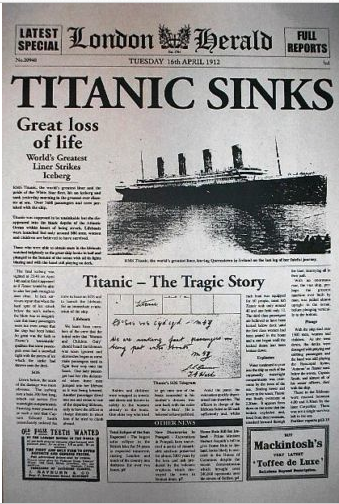
Although I did wonder about the accuracy of this family legend, after talking to members of the family in Scotland who remembered the same story, and seeing the timeline of the family history and Elizabeth's death, I have less reason to doubt it now, and I wonder if her connection with the Miller family had anything to do with her ability to get a ticket, or her choosing that ship.  It is also quite possible that she had a ticket for another ship and would have been moved to the Titanic.  Due to a shortage of coal that a strike had caused, passengers from the Oceanic and Adriatic (both also White Star Line ships) along with their coal stores, were moved to the Titanic at the last minute.  In any case, she was supposed to be on the Titanic and cancelled her plans because of Elizabeth's illness.
Had she been on the Titanic, she would surely have been in Steerage (third class) and would have died.  So, because of Elizabeth's death, our line of the family exists.  
It is a strange thing to know that you got life because someone else died.  But, then, I am not alone.

Her trip eventually happened on the S.S. Athenia of the Donaldson Line.  It left Glasgow on the 14th of September, 1912, and arrived in Quebec on the 22nd.  It also stopped at Montreal.  After landing in Canada, Nellie would have taken a train across to Vancouver.  She was only 21 years old - quite an amazing trip for such a young woman to take by herself.  After the tragedy and loss of life on the Titanic, it must have been somewhat nerve-wracking to get on a steamer and head into the Atlantic.

We are very fortunate in our family to have a typed copy of a letter she sent.  She would have hand written it, so this typed copy was done by someone else.  There are some inconsistencies in it - for instance, someone typed at the top of the page that she took the SS Athenia to the USA and then to Canada.  I have not seen any evidence for the ship stopping in the US.  Also, the dates are a week off - perhaps someone added the date later and was incorrect.  In any case, it is a good summary of what she experienced on the ship.  It is also the only thing even close to a daily account of her activities that I have ever seen.  The only other writing I have of hers is on a few of the postcards.


Here is the text of the letter with corrected dates:

"Saturday 14th Sept. 1912.  Sailed from Glasgow 11:30am.
We have just started on our journey.  I saw Aunt Maggie standing on the dock at Glasgow until we were a good way out to sea, it is a lovely day and just like a pleasure sail.  Arriving at Greenock; a few more passengers are taken aboard, a woman came up to me, then in conversation with her, she told me she was going to Vancouver; she had six children with her and was going out to her husband. I was quite pleased to think I should have her company all the way.
On going down to my cabin to see who my companions are, I found a lady and a young girl; The lady (an American) was married; and the young girl like myself, going out to be married.
The sun is shining lovely; I am informed that we have no more stoppages until we reach Further Point [can't find this place, but I assume somewhere in Newfoundland] the journey will be almost over then.
Lunch time; off we go to get it, I feel hungry:
I enjoyed it splendid; it was much to my taste.  There is a nice music room containing a piano where we can sit if we choose; but as it is at the extreme end of the steamer it is not much patronized; because when you sit down you can feel the vibration of the ship and it inclines to make one sea-sick; and we all want to avoid that if possible.
Dinner time; then tea time came, then off to bed.

Sunday
I had a good night's rest: I wondered a little where I was when I awoke and heard the sea roaring.
After getting up I go and have breakfast after which I feel a little sick; not much.  If I never get worse I shall be fortunate; A great number of the passengers (numbering 135) [which, by the way, is not what the ship's manifest states at 372 - perhaps she was talking about Steerage] in all are terrible put to with sea sickness, half the passengers are children it is heartbreaking to see the poor things afflicted with sea-sickness and yet I am unable to do anything for them.  It is very foggy this morning, the steamer keeps sounding her "Fog Horn" and it makes such a peculiar sound.  AT 10:30am a religious service is in course.  I went in, but feeling a little sick I came out again, and going to my cabin all afternoon; not that I was tired or sea sick but it was very cold up on deck, the stewardess brought my tea down to me.  Dinner time came round, I went up to the dining room for it and enjoyed it splendid then after a short time retired to bed.

Nellie Steele

Monday
It is a lovely morning; no fog but there is nothing to be seen save the Heavens above an the Ocean through which the steamer is ploughing her way.  Breakfast at 8am a cup of beef tea at 11am they are very good to us, that is with food.
Many more passengers are sick today; I am feeling well but I am getting tired of the boat.  Jack said when he sailed it was the best holiday ever he had.  I am sorry I can't say that - I am quite tired of it already.  I shall be glad when I reach Vancouver.  They tried to get up a concert every afternoon at 3:30, but every body seemed to have quite enough to do to look after themselves without trying to amuse others.

Tuesday
Another foggy morning; I was awakened early by the sound of the fog horn.  Today we have given up our steamer tickets and received tickets for our inland journey (on the train) in exchange.
The SS Hyperian [possibly Hesperian] passed us at 4 am on Sunday; she is now 150 miles ahead of our ship.  The officials of this steamer have received a wire from her stating that they have encountered a heavy storm; we expect to have this storm also.
Today I met another young lady going to Vancouver.  The lady I spoke to at Greenock has been sick all the way I feel heart sorry for her.  As I go to bed a heavy storm is rising on the sea, and continues all through the night, but towards morning it abates a little.

Wednesday
I am sick today but I am not going to bed as I find walking about is better for me than lying down; I took a little brandy; it relieved me so I hope I am done with sea sickness.  I have not missed a meal since I boarded the vessel.
The waiter was chaffing me, saying that I deserved for keeping up so well for the first journey at sea.  I have been up on the top deck today watching the porpoises, it was lovely to see them; and there was such a large number of them, they followed us quite a long way.
A great number of birds are following the vessel, but I don't know what species they are: they are new to me.

Thursday
I got up this morning feeling unwell, last night was the worst I have had at sea, but I shall go and have a cup of tea after which I'll go back to bed all fore-noon: I've not kept up to my record today as I've not been able to go for my lunch.  The stewardess brought me down a cup of tea, she says it is only a slight cold that I have got and that I will soon be all right.  I went up and had my dinner, I enjoyed it very well, considering that I was not well.  I went right away back to bed after dinner; not that I was in need of it but being a little unwell I felt that my company would be a bore to anyone.

Friday
I am all right again today.  But it is terribly cold.  The steamer was stopped for 5 hours during the night on account of thick fog and a stormy sea which will delay us considerably as long as it lasts.  The storm and the fog has also delayed the Hyperian [again, Hesperian?].  She is now only five miles in front of us.  Towards mid-day most of us were up on deck seeing an iceberg it was a very large one, it makes me shudder to look at it.  This has been a terrible lonesome day today it is so cold we are obliged to stay in our cabins to keep warm.  I brought some work for me (crocheting) but I am sorry to say I have been unable to do any of it for whenever I sit down to it my head begins to sway, and I don't want to give way to sickness now after holding out for so long.
There are still a great number of passengers sick, and I have so much to be thankful for as I have not been bad, but I am tired, tired of the sea.
We are expecting to see land today about 4 pm, it is not 1 pm yet.  On going to lunch, we had not been seated two minutes when a great commotion was distinctly noticeable i wondered if a collision had taken place, but I was informed that we had sighted land.  I went on deck and saw Belle Island on one side and Newfoundland on the other, and five huge icebergs, everybody was glad to see land but it will only be for a short time.  Belle Island is covered in snow; a light house is also to be seen on it.
The mail goes this afternoon so I'll send you this just now.  The sea is not quite so stormy, it is extremely cold, of course that it caused with us being in close proximity to the icebergs.
We expect to reach Montreal on Tuesday then I have six days in the train after that."

At the end of the letter, there is a line and then another little jot, which I suspect may have been sent on a postcard.  The dates are wrong on this one, too.  "I had a pleasant journey on the train arriving at Vancouver on October 5th.  The wedding took place on Wednesday October 9th [they were actually married on October 2, 1912].  Everything passed off successfully.  The Reverend George D. Ireland conducted the service."

I really do wonder why the dates are incorrect.  That is a mystery that may never be solved.


#30 - Randolph's Leap

This postcard is of Randolph's Leap in Morayshire, near Forres, Scotland.


The back of the postcard reads:  "Just spending the day here.  Having a rare time.  Expected to hear from you this week.  Sarah" - the last sentence appears to have been added as an afterthought.  It was addressed to Jack McCurrach via box 128, Fraser Avenue P.O., Vancouver, BC, and was mailed from Forres on July 22, 1912.  Jack had been in Vancouver for 2 years already at this point.  Aside from a PO Box number, and the note of an expectation of correspondence, there is very little new personal information to be gleaned from this postcard.  But the subject matter is quite interesting.

Randolph's Leap is on the Findhorn River which winds its way through the countryside.:


The sign at the head of the trail reads:

"THE LEGEND

Randolph’s Leap is the name given to the narrowest point at the entry to the gorge.  In fact it is a misnomer as it was not Randolph who leapt!  

In the 14th century, Thomas Randolph, Early of Moray, lived on the far side of the River Findhorn at Darnaway.  Sir Alexander Cumming and his six sons lived on this side.  The Cummings had traditionally held the lucrative post of ranger of the Forest of Darnaway.  However, they were out of favour with Randolph and his uncle, King Robert the Bruce, and Randolph told them to keep off Darnaway.

Alastair, the eldest son, gathered a thousand men to attack Randolph at Darnaway.  They were ambushed and retreated to the river where Alastair and three others leapt the gorge back to this side.  We can only wonder why it was not called “Alastair’s Leap.”

THE MORAY FLOODS OF 1829

Following an unusually hot and sultry summer immense rain clouds settled over the Monadhliath Mountains in early August.  The rain started on Sunday 2nd August and continued for three days and nights.  The River Findhorn and its tributaries rose to an enormous height causing devastation through the whole valley.

At Randolph’s Leap the level rose by 50 feet and is marked by the two flood stones.  You can begin to imagine the power of the water when you see the huge lichen-covered boulders which the flood carried as far as the Leap."


The area is located here:


And at a larger scale, here:


Randolph's Leap is nearest the community of Forres (where the postcard was mailed).  Forres is a town and former royal burgh located about 25 miles east of Inverness.  Its earliest historical reference may have been in the 2nd century in the Geography of Claudius Ptolemy.  Coming from Canada, that is absolutely amazing to me.

You can find out more about Forres here.


#29 - Woodpark Asylum, Boyndie

Again this one isn't about a postcard.  But it reflects an interesting and troubling part of history.

My Great-Grandmother, Nellie (Helen) Steele, of whom I have talked a lot, was born on February 23, 1891.  I got her birth record from Scotland's People.  Although www.ancestry.ca is a great resource, it can be limited.  The actual census documents are not always available to see, so if anything is misinterpreted or transposed incorrectly, the error cannot be seen by the user.  Scotland's People is more expensive (well, on an individual record basis - depends on how much you use it), but you can access copies of the actual documents.  And that is what I did yesterday with my Great-Grandmother's birth record.  It's interesting because she is half of the only set of twins I currently am aware of in our family - so the same information is recorded for her and her brother, William.

Her mother is also listed - Helen Steele, whom my great-grandmother was seemingly named after.  Her maiden name was McKenzie.  Their wedding date is noted as July 27, 1883 in Banff.  All important information for doing genealogy.

So I dug a little deeper to see if I could find anything out about Helen McKenzie.  She is listed in the 1881 census as living at the Woodpark Asylum; she was one of two servants at the asylum, being an attendant.  There were also the Matron, a cook, and 24 "Pauper Patients" listed on the census.  All of the patients were women who were aged from 34 to 88 years old.

I can't find a lot of information yet on the Woodpark Asylum, but I did find out that it was opened in 1880 about 1 mile distant from the Ladysbridge Asylum, and 9 years later it was amalgamated into the same.  I have not been able to locate the Asylum on a map or on Google Earth.  If anyone from the area has that information, I would be really grateful.

But since I can't find Woodpark (yet), I thought I'd share with you a wonderful photograph of the Ladysbridge Asylum that I found at "Britain From Above" - a great website that has some fantastic aerial photos from 1919-1953.

Here it is:


A gorgeous bit of architecture, really.  This building was originally constructed 1863-1865 - or part of it was.  I don't have the plans to detail how much of it was constructed at that time.  please note the extensive gardens which were undoubtedly used to feed the patients and staff, and were probably also used as therapy for the patients.

The architects for this building were Alexander and William Reid (A & W Reid) of Inverness.  Apparently the Woodpark Asylum is also in their style, but it is not known who designed it. (Information from the Dictionary of Scottish Architects).

So I am dying to see a picture of Woodpark Asylum if anyone can point me in the right direction.

The irony really is that my 2x great-grandmother worked at a psychiatric asylum.  If I had lived in the 1880s it is entirely possible, with untreated depression and anxiety, that I would have ended up there as a patient - as could have a lot of her descendants on my side of the family.  (I also don't doubt that some of these women were there simply because they could not afford to live anywhere else - or for many other reasons other than "insanity").

Post Script - as you can read the details on in this later post, I was contacted by someone who had a photograph of Woodpark Asylum (aren't people awesome?).  Here it is - it would have been located to the left of the Ladysbridge Asylum in the picture above:


Saturday, December 19, 2015

#28 - Sarah Mystery Solved!

This postcard was sent "To A Scot Abroad From A Scot At Home."  It was sent October 6, 1911 and arrived at the Fraser Avenue Post Office in Vancouver October 18.


I am slightly disturbed by the breath blowing out of this man's mouth (not sure why), and the seeds that remind me of the dreaded dandelion, but other than that, it's a nice sentiment.  This postcard, possibly due to it's texture or light colour, is particularly dirty compared to most of the others in the collection.

The rampant lion is a common motif in heraldry and is a primary part of the Royal Coat of Arms of Scotland.  Can someone tell me if this particular form of lion with thistle leaves and berries is seen elsewhere?

Four postcards previously (#10 - Madeira#13 - Seaforth Highlanders#18 - the MacLean Memorial, and #24 - the Burning of the Clavie) , I've talked about the author of this postcard.  Her name is Sarah and she was from Burghead, on the coast just to the northwest of Elgin.  Up until now, I wasn't entirely sure who Sarah was, but in this postcard is the last piece that puts this puzzle together:  "D.J. Thanks very much for nice P.C. Glad to hear you are getting on well.  I had quite given up hopes of hearing from you again but when I did it was with a vengeance.  We are all quite well just now.  Maggie is at home for a few weeks just now.  Poor Anna had to come home owing to bad health.  She is pitiful right now Jack.  you would hardly know her.  I don't think she will ever get better.  Yes there is great word of the "Kilties" just now.  They are to camp in the Brock next year.  We will miss you seeing the C.B. Tartans are to be there.  Kindest regards.  Sarah."


The 1901 census shows us that Sarah Sandeson, the daughter of William and Isabella Sandeson, had a sister named Maggie, and one named Annie.  So our mystery is solved.  We have a name and a family, but I'm still not sure what relationship the families had with each other - likely friends, possibly relatives.  I'll have to look a little further into that.

She mentions the "Kilties," which the "Free Dictionary" (quoting Random House) defines as "a person who wears a kilt, esp. a member of a regiment in which the kilt is worn as part of the dress uniform."  From the context it sounds like military men were congregating there for camp. This is the second time she mentions the C.B. Tartans.  Jack was a member of the 4th Cameron Highlanders, and I suspect that this is what she is referring to.

The "Brock" is noted in "Notes on Burghead" (p.45):  "In a summer evening, with a smooth sea and a gentle breeze playing on the waters, no more pleasant seat can be had than on the top of the 'Brock Bailies' (by which name the high ground above the harbour is designated), and the outlook on the clear blue sea, with the mountains of Boss, Sutherland, and Caithness in the distance, and the magnificent entrance to the bay of Cromarty, lighted up with the rays of the setting sun."  If there is anyone out there familiar with Burghead, perhaps you could confirm where that area is/was.

More personally, she is expressing her fear that she was not going to hear from Jack anymore.  And the indication is that he is busy and losing touch with his Scottish friends.  Something that was liable to happen, and all too common with people who moved so far away, I'm sure.


#27 - Seaforth Cottage, Garmouth

So the other day I posted a "Photograph" of Jack McCurrach's sister (Nellie), her husband (John Moir Smith), and their 3 children.

They are photographed in front of "Seaforth Cottage," Garmouth, Moray, Scotland:


Well, it turns out this was actually a "Real Photo" postcard (I just needed to turn it over ... darn it!).  Real photo postcards were ones that were taken of people and printed onto postcard paper - they were introduced in 1902 by Kodak, and people could take their own postcard pictures:


Unfortunately, it was never written on or post-marked, so it provides us with no clues about the family, but these types of postcards were certainly interesting in themselves.  It tells some about communication at the time - the fact that photographs were available to people for such purposes - and that this family had enough money to use the service.  They (or a friend) may have had their own Kodak camera for this purpose, or they may have paid for the service of a professional.  I would assume that this is one of many they sent to friends and families.

Today I was looking through Google Streetview at Garmouth to see if I could find the house.  I tried a couple of days ago to no avail, but today I found reference to the house possibly being on High Street, so I took a really close look.  And, by golly, I found it - and it was confirmed by someone on the Garmouth and Kingston Village Hall Facebook site.  Thank you so much to that person who is now trying to hook me up with someone who can give me some more information about the house (sorry, I don't know your name!).

(again, thank you Google Maps and Streetview!)

It has been added to on one side and the front (and maybe the back, can't tell with this picture), but it IS the same building.

Also interesting, after only knowing that this man was "Regimental Sergeant Major Smith" (my Great Uncle Jim, who was in England in WWII, and met the little girl in the picture who was then about 20 - and he may have met his aunt and uncle, although I don't know that for sure), I now know that his name was John Moir Smith.  He was indeed a Regimental Sergeant Major with the Seaforth Highlanders, which he joined in 1888 (when he was 20).  From "The Morayshire Roll of Honour" (1922), we find out that he: "served in France and Germany; awarded Distinguished Conduct Medal, Queen Victoria's Sudan Medal, North West Frontier Medal, Long Service and Good Conduct Medal, and Khedive's Medal for Atbara, Chevalier de l'Ordre de Leopole II, Croix de Guerre, and Meritorious Service Medal."  From this list, I have learned that he served in the Sudan, India, and the Congo.  And since the book is about the men and women who took part in the Great War, he also served in WWI - that's what "served in France and Germany" means, I'm thinking.  

So by the time he got married to Helen Jane McCurrach in 1911 (14 years his junior), he had lived an adventuresome life as a soldier on other continents, and then served again after they were married.  No wonder my Great Uncle Jim (Jack's son) was so impressed by R.S.M. Smith and remembered him by his rank rather than his first name.  

Nellie was the third child of Jack's parents John and Susannah, and was given to an aunt and uncle to raise.  She certainly ended up in "better circumstances" than her parents had been in.  

When my uncle Jim met his 20-year-old cousin, she apparently said:  "I dinna kin when ya from, but I know you're a McCurrach."


Sunday, October 18, 2015

#26 - The Hollow Tree in Stanley Park

If this is your first visit to the site, please read The Introduction if you want to know more!


So now we have our first postcard actually FROM Vancouver.  I'm far more familiar with Vancouver - having lived there for 7 years while going to university - so I'll hopefully be able to give a little more information than I could for Scottish locations.

This postcard features "The Big Cedar Tree" - it is also known as "The Hollow Tree."  It is located in Vancouver's Stanley Park, and is being conserved because of it's history.  It is probably the most photographed tree in Vancouver's history as it has long been a common spot for people to stop and get their picture taken.  Google "The Hollow Tree in Stanley Park" and you'll find all sorts of people posing for their pictures - from buggies to cars - standing or sitting -  it was a popular place to go.


Stanley Park is a large, urban park located to the west of Vancouver's downtown.  It houses an The Vancouver Aquarium, playing fields, forest, a great hike and bike trail, the terminus of the famous Lion's Gate Bridge, restaurants, hungry racoons, evil geese (I know from personal experience), and myriad other attractions (as well as homeless people and drug dealers, but let's not sully the picture).  I have spent many happy hours in that park.

Stanley Park on Google Maps

Here are some shots I took around 1994/95 when I still used a film camera and often rode my bike around the park (they hang on my office wall - I've always liked them):


Now the back of the postcard is addressed to "Miss N. Steele / Feugh Lodge / Banchory / Kincardineshire / Scotland" and the postmark, which is barely visible, shows it was sent sometime in 1911.  The text reads:  "Dear N.  This is Vancouver's famous tree.  I'll show it to you bye and bye.  I am wiping off arrears just now.  There are some people I have not answered since December.  Shameful isn't it.  Im sending Mrs. W. one too.  Love from J.M."

This is the first time we see "Love" written on any of the postcards.  Postcards were a public way of sending messages.  They were not normally written to express emotions - letters enclosed in envelopes were a better way of doing that.  So Jack must have really been missing Nellie by this point.

An interesting thing about this postcard is that it is from The Valentine & Sons Printing company based in Montreal and Toronto and was printed in Great Britain.  So it went all the way from Great Britain to Vancouver just to be sent back again.

Oddly enough, Valentine & Sons started in Dundee, Scotland.  It printed it's first postcards in 1898 and it's first Canadian postcards in 1906.


Friday, October 16, 2015

#25 - Jack's Family History

And here comes some rather disturbing family history, which I knew nothing about until now.


My Uncle Jim (actually my mother's uncle, my Great-Uncle) told me that this was his aunt - his father's sister, Nellie - and her husband, "Regimental Sergeant Major Smith" (John Moir Smith, 13 years her senior, and a member of the Seaforth Highlanders) along with their children.  It was taken in front of Seaforth Cottage in Garmouth.

What was interesting was that I never did find Nellie (Helen) in the census records, so I was wondering if my Uncle Jim was a little confused.  But he was pretty certain about it.

So this past week I was in touch with one of my mother's cousins and got a list of the children in my Great-Grandfather's family (himself included).  And there were 12 listed.  I've only come across the evidence for 5 of them, so again I was wondering if someone was confused.  But they weren't.

My Great-Great-Grandmother, Susannah McCurrach and her husband John, had 12 children.  The third born, Helen Jane (the woman in the photo), was given to an aunt and uncle (Alexander and Ann McIntosh).  The 7th through 12th children (Elspet, James, Robert, George, Susanna and Margaret) all died after Susannah was 35.

I did mention in the last post that one of the children died of Tubercular Peritonitis and one of Marasmus (malnutrition).  I had the order mixed up, though.  Those were the first (at 5 months) and third (at 7 weeks) children to die (not the first and second).  The second, James, died at 3 months from "(Supposed) Marasmus from Birth."  Not sure what that "supposed" means.  Did they not believe the parents?

The fourth child to die was George McCurrach, who died of Gastric Catarrh at the age of 2 months.  The fifth, Susannah, from Gastro-intestinal Catarrh at the age of 7 weeks, and the last, Margaret, from Marasmus at the age of 4 months.  All of those afflictions can be traced back to malnutrition.  Also remember that my great-grandfather, Jack, was only 5' 1 1/2" tall - probably also due to malnutrition, since his children were all average heights.

Several things have been going through my mind this week:  were they all malnourished?  Was Susannah (the mother) malnourished?  Did they just not have the money to feed more mouths?  Did they allow the children to die in order to feed their other children?  Could Susannah just not handle having any more children and let them starve?  How does a mother bury 6 children in the course of 10 years?  (Or - hopefully not, but knowing the anxiety and depression that runs in our family - could Susannah just not handle any more kids?  It may have simply been infanticide.  But I can't make that call.  I can't make that assumption.  Not without proof.)  Why didn't they give more of the children away?  What changed?  This certainly is a situation where it raises more questions than it answers.

Other things have also been going through my mind.  I have nothing on the face of the Earth to EVER complain about.  I have it so good I can't even imagine living like these people appear to have done.  I used to think that in gardening and canning and such that I was following in my ancestors' footsteps.  But at least for a while, it seems they couldn't even afford to have any land to grow food on.  Food must have been so hard for them to come by.

So more questions abound and I'm not sure I will ever be able to answer them.  But I'll try.


#24 - Burning of the Clavie

I think I filed this one out of order as it is sent to Jack in Nairn - seems it might have been February, 1910.  It was sent from Sarah in Burghead.  We've seen other postcards from her:  one sent from Burghead but a postcard showing Madeira, Portugal; one showing the colours of the Seaforth Highlanders; and one showing the Maclean Memoiral in Burghead.


This card, however, is more culturally based, showing one of Burghead's unique celebrations.  It is the Burning of the Clavie, a continuation of a New Year's Eve ceremony that takes place on January 11th - the eve of the new year on the Julian calendar.  After the Gregorian calendar was adopted, the people of Burghead decided they would celebrate twice (knowing the Scottish reputation, I'm assuming it involved some alcohol). A barrel is split, put on a pole, filled with tar, and lit on fire - the Clavie (they may, by the look of it, now have a permanent Clavie that staves are put into - any Burghead people want to add to this?).  It is then carried around the town to a pile of other split barrels where the Clavie is placed.  When it falls apart, the fire spreads to the other barrel bits.  People collect pieces of the burning wood to start their New Years fires, and charcoal from the Clavie is put up the chimney to keep out bad spirits.  I am sure there is a much longer story steeped in further tradition and belief, but this is the best I'm going to do at the moment.  It sounds like a fun time.


Here's the back of the card:


"How are you always getting on.  Still as busy as ever I suppose.  I intended sending a P.C. long ago but we have had such a lot to think about lately that it quite escaped my memory. Are the "Kilties" still flourishing in Nairn.  They are multiplying here.  Their ball was last week.  How do you like this view of our clavie.  It is Alicm (?) Franks masterpiece at present.  Hope you are all well at Nairn.  S.S."

The initials narrow down further who Sarah might have been.  If you remember, in the Seaforth Highlander's postcard post, there were three Sarah's who were about the right age to be friends with Jack:  Sarah Robertson, Sarah Sandeson, and Sarah Stewart.  So now we are narrowed down to 2.

I'm not sure who A. Franks was - and not sure if he/she painted the picture or was in charge of making the Clavie.  Anyone have any ideas?

On a different note, I've found out more family information.  I've been in touch with my mother's cousin (one of Jack's grand-daughters).  She is quite interested in genealogy and had some information that I did not yet have.  A relative of ours in Scotland had researched Jack's family - his brothers and sisters.  The list had 12 children noted.  Since I had only ever seen 5 children named in the censuses, I assumed that relative had done something wrong or been confused.  But when I found the original of the 1911 census, I found out that he was right:


The column headers in the last 3 columns read:  "Duration of Marriage," "Children born Alive," and "Children Still Living."  According to the relatives letter and the census material I've seen, the first 6 children lived.  The last 6 children died.  I'll have to do some more serious research to find out what the situation was for each of the children (or my Mom's cousin will).  I'm curious about what happened.  Also, I see from this relative's research that there was an older daughter named Helen Jane McCurrach who was called Nell or Nellie.  I assume she got married and stayed in Scotland.  Again, more research required.  

But I can't help but weep for Susanna and John McCurrach losing 6 of their 12 children.  Lordy.  

The child mortality rate in 1900 in Britain was about 14%.  This family's was 50%.  I did look up the first of the children to die, and she died of Tuberculous Peritonitis.  The next in line died of "Supposed Marasmus from birth" - malnutrition.  Meaning that Susanna didn't have enough to eat, either.  To think that they didn't have enough to feed their children or themselves.  Maybe that's why Jack was only 5' 1 1/2" tall.    

... And my heart breaks.  


Friday, October 9, 2015

#23 - The Scott Memorial

On August 30, 1910, someone named John sent Jack, in Vancouver, a postcard from Edinburgh.  The text reads:  "Thanks for the P.C. which I duly received.  Glad to hear you like your new surroundings, and hope you will soon get into their way of working in Vancouver.  I am spending a short holiday in Edinburgh with Dave, and am enjoying myself first-rate in spite of wet weather.  Write me a letter soon.  Kindest regards, John."


The comparatively excellent grammar, sentence structure, etc. in this postcard make me think that perhaps this man worked with Jack at some point.  Jack was a compositor - he set type for printing.  He was listed as a "printer" when he travelled to Canada, and had worked for the County Press, Nairn, for 8 years by that time.  I have found a reference to the St. Ninian Press and the Nairnshire Advertiser and County Press.  It was started by John Fraser as the St. Ninian Press in July, 1892 and changed names to the Nairn County Press and Advertiser on July 24, 1897.  The paper ceased production in July 1917.  Reference found here.

So I don't know if the signee, John, was his employer John Fraser, or if it was another John (although the grammar and penmanship certainly don't discount him).  And I do not have any idea who Dave may have been (and given their exceedingly common first names, I probably never will), but the text tells us something.  It indicates that there is some culture shock.  That Jack has expressed some concern about how he fits in and how people in Vancouver do things.  I suspect he might be finding it hard to get a job - and I say this because the Vancouver city directory of 1911 list both of Jack's brothers and their jobs, but not Jack - although we know he was there because he came with his younger brother.  Of course, he may have just been missed in the survey for the directory, because in the 1912 version, he is listed as working for G.A. Roedde (the owner of a printing company) and his brother, William, is missing.  Jack and his older brother, Alexander, are both living at 434 29th Avenue E in Vancouver at this time (near Fraser Avenue, which was mentioned in the last post).

The front of this postcard is of the Scott Memorial in Edinburgh:


Now known as the Scott Monument, this edifice was erected in the memory of Sir Walter Scott, a famous 18th and 19th century author.  Okay, so most of you probably know who Sir Walter Scott is - I really didn't.  I knew the name.  In looking him up, I find out he was a pretty big deal.  He was the first English-language author to become internationally renowned within his lifetime.  He wrote Rob Roy and Ivanhoe (as well as a lot of other great works).  I'm fairly embarrassed, as the descendant of proud Scottish stock, to not really know who this man was.  I do know Robert Burns, though.

After Scott died in 1832, a competition was held to design a monument to him.  George Meikle Kemp won the honour of designing it.  The statue at the base of the monument was designed by Sire John Robert Steell (I wonder if there is a distant family relation to Nellie Steele).  The monument was completed in 1844.

At a total cost of 2.36 million pounds, the memorial was restored in the early 1990s.

I like the fact that there are palm tress in the picture.


#22 - Feugh Lodge and John Poynter Miller

I've already talked about Feugh Lodge in a previous post.  This was the home where my great-grandmother, Nellie, worked as a kitchen maid from 1910 until 1912.  There are a couple of postcards in my collection that show the Feugh River that runs beside the house.  One was mailed, the other only has a brief note (I'm skipping forward a bit here in the chronological order of the postcards - humour me).

Here's the one with the message:


It is obviously a coloured photograph of the Feugh River while flooding.  I don't think I'd want to be near it when it did this.  But Nellie was as you can see from her note:  "Feugh Lodge 24/10/11 Thank you so much Jack for the nice views I received this morning.  They are lovely.  This is what the feugh is like today.  Nellie"  She was working here by August, 1910, so she had been here for over a year when she sent this postcard.


This one is also postmarked twice - like the postcard of the football game.  This one is postmarked Banchory, Kincardineshire (the community closest to Feugh Lodge) and then postmarked Fraser Avenue, BC.  The Vancouver-Fraser Avenue Post Office was established December 1, 1910 - not even a year before this postcard was received by Jack.  You'll note that he was picking his mail up there - and it was obviously coming over by ship and rail.  There is no Fraser Avenue in Vancouver anymore.  In 1948 it was renamed Fraser Street.  You may also note that postage to Canada is two half penny stamps - as opposed to just one within Scotland.


This card, part of the same series by William Duncan, a photographer from Banchory, was a view of the river when it wasn't in flood.  It must be interesting to live near this river.  On the back is a note from Nellie reading: "This is a bridge, about a ten minutes walk from the House.  Nellie"  I assume this one was written shortly after she moved there, but since it was mailed in an envelope or handed to it's recipient in person, we won't know exactly when it was sent in her two years living and working here.

Aside from the postcards and the information they contain, I've written this post now to fill you in on the owners of Feugh Lodge where Nellie, my great-grandmother, worked and earned money to help establish her new life in Vancouver.  Over the last couple of days I've been able to research them a bit and it's quite interesting (let me tell you, if your family was wealthy, there's a lot more to research and it's MUCH easier!).

John Poynter Miller was the owner of Feugh Lodge and my great-grandmother's employer.  He owned the lodge and at the time the 1911 census was taken, was the head of a household made up of his wife, 4 female servants, and a chauffeur.  He was obviously wealthy and, in turn, considered important.

First off, let's talk about finding his name.  Here is the census record with his name noted:


Okay, you tell me, what is that middle name written in there?  At first I thought it was Doyscher. Doyscher is actually a last name (I'm thinking German?), so I thought that was a possibility.  But no luck finding him anywhere.  So I took a closer look at the census.  On the other page his occupation was stated:
 

"Chemical Manufacturer" - so I searched for that: "John Miller Chemical Manufacturer."

Well, that cracked the door open a bit.  I found his father, John Miller senior (1816-1894), who had founded a chemical manufacturing business in Aberdeen with his brother, George.  It was called John Miller & Co. and it was housed at the Sandilands Chemical Works in Aberdeen (which was also established by the company).  They made chemicals - sulphuric acid, sulphate of ammonia, etc.  They also were tar distillers, oil and paraffin wax refiners, and manufacturers of artificial manures (apparently before they were called fertilizers).  They were in on chemical fertilizers from the beginning - something that went hand in hand with gas manufacturing for WWI.

The 1871 census shows the family living at 14 Crown Street in Aberdeen:


It would appear that Miller's son, John Poynter Miller, was a partner in the firm by 1890, which would have made him 26 as he was born in 1864 (they sold the company in 1928).  As of the 1891 census, J.P. Miller was then living with his parents at 10 Queen's Terrace in Aberdeen (a little nicer than the last one, but that one wasn't bad, either, really, was it?):


He seems to have lived there until after they died, and still lived in their home in 1901 with a lot of other people.

Here is a map showing 14 Crown Street, 10 Queen's Terrace and Miller Street (where their business at Sandilands was located):


By 1909, John Poynter Miller had moved out of the house and on July 3, at the age of 44, married Edith Margaret Cochran (also from a wealthy family) in London.  They apparently moved to Feugh Lodge after getting married and had hired their housemaid, Nellie, by August, 1910.  (Poynter, really?  Well, after finding it, I can match the letters on the census form, but it really doesn't look like Poynter, does it?).

One last thing - there was always a story in our family that Nellie stayed later in Scotland than she intended because her sister was pregnant and died giving birth.  Nellie, having been a children's nurse, had helped care for the baby before going to Canada after she was adopted out (her name being Peggy Black).  I could find no evidence of Nellie ever being a nurse.  I thought maybe it had been some confusion over the years.  But today, at the University of Alberta Library, I was able to access a page from the London Standard.  A birth announcement came out on August 15, 1911:  "MILLER - On the 10th Aug, at Fengh (sic) Lodge, Banchory, Kincardineshire, the wife of John Poynter Miller, of a daughter."

So she had been caring for the Millers' child at Feugh Lodge and had very recent knowledge of newborns when her sister died.  Family story confirmed.